
Browse "Economy"
-
Article
Functionalism
FunctionalismFunctionalism is a concept of world order developed in the early 20th century by such writers as Leonard Woolf and David Mitrany, who argued that if nations joined in economic and social interdependence, and if national well-being depended upon the maintenance of peace, then war would be less likely. This theory influenced the founders of the UNITED NATIONS, with its specialized functional agencies and its organs for security and for economic and social questions. Canadians...
"https://development.thecanadianencyclopedia.ca/images/tce_placeholder.jpg?v=e9dca980c9bdb3aa11e832e7ea94f5d9" // resources/views/front/categories/view.blade.php
https://development.thecanadianencyclopedia.ca/images/tce_placeholder.jpg?v=e9dca980c9bdb3aa11e832e7ea94f5d9
-
Article
Fur Industry
The Canadian fur industry consists of companies that buy raw furs from trappers, dealers or fur-marketing companies (e.g., Hudson's Bay Company raw-fur auctions), send them to fur dressers and dyers in Toronto, match the skins and cut and sew them into garments. Most manufacturers make coats and most specialize in two or three types of fur only. Before the coat can be finished, it must go through a fur-cleaning process and some companies do only this. Some cleaners also maintain cold fur-storage vaults to house furs during the summer, but many retail furriers also have their own vaults. Fur factories are generally small, with 279 of the 280 factories employing fewer than 50 people; only one of the 280 operating factories employed more than 100 people in 1986. In that year there were 3,700 furriers in the manufacturing work force, with about 2950 in Quebec, 675 in Ontario and 75 in Manitoba. Almost all fur companies are Canadian owned; there is some foreign ownership, mainly American, in the retail sector and some Japanese investment in the manufacturing sector.
"https://d2ttikhf7xbzbs.cloudfront.net/media/media/a4d6e476-5e53-4126-9ee6-313b64235660.jpg" // resources/views/front/categories/view.blade.php
https://d2ttikhf7xbzbs.cloudfront.net/media/media/a4d6e476-5e53-4126-9ee6-313b64235660.jpg
-
Macleans
Fuss Over Ontario Salaries
The meeting of hospital administrators last week in Toronto was overshadowed by a very personal issue: the participants' salaries.This article was originally published in Maclean's Magazine on April 15, 1996
"https://development.thecanadianencyclopedia.ca/images/tce_placeholder.jpg?v=e9dca980c9bdb3aa11e832e7ea94f5d9" // resources/views/front/categories/view.blade.php
https://development.thecanadianencyclopedia.ca/images/tce_placeholder.jpg?v=e9dca980c9bdb3aa11e832e7ea94f5d9
-
Article
Canada and the G7 (Group of Seven)
The G7, or Group of Seven, is an international group comprising the governments of the world’s largest economies: Germany, France, Italy, Japan, the United Kingdom, the United States and Canada. It was founded as the G6 in 1975 and became the G7 with the addition of Canada in 1976. The Group is an informal bloc; it has no treaty or constitution and no permanent offices, staff or secretariat. The leaders of the member states meet at annual summits to discuss issues of mutual concern and to coordinate actions to address them. The meeting location and the organization’s presidency rotates among the members. The European Union is also a non-enumerated member, though it never assumes the rotating presidency.
"https://d2ttikhf7xbzbs.cloudfront.net/media/new_article_images/G7/G7_summit_at_Shimakan.jpg" // resources/views/front/categories/view.blade.php
https://d2ttikhf7xbzbs.cloudfront.net/media/new_article_images/G7/G7_summit_at_Shimakan.jpg
-
Article
General Agreement on Tariffs and Trade (GATT) (Plain-Language Summary)
The General Agreement on Tariffs and Trade (GATT) was an international trade agreement. It was signed by 23 nations, including Canada, in 1947. It came into effect on 1 January 1948. It also led to the creation of the World Trade Organization (WTO) in 1995. The GATT was focused on trade in goods. It aimed to reduce tariffs and remove quotas among member countries. The GATT helped reduce average tariffs from 40 per cent in 1947 to less than five per cent in 1993. The GATT was an early step toward globalization. The WTO replaced the GATT on 1 January 1995. This article is a plain-language summary of the General Agreement on Tariffs and Trade (GATT). If you are interested in reading about this topic in more depth, please see our full-length entry: General Agreement on Tariffs and Trade (GATT).
"https://d2ttikhf7xbzbs.cloudfront.net/media/media/56003d5b-0a71-405a-8a17-f397815e78a0.jpg" // resources/views/front/categories/view.blade.php
https://d2ttikhf7xbzbs.cloudfront.net/media/media/56003d5b-0a71-405a-8a17-f397815e78a0.jpg
-
Article
Globalization
Globalization is the process of integration and interdependence of people and countries around the world.
"https://development.thecanadianencyclopedia.ca/images/tce_placeholder.jpg?v=e9dca980c9bdb3aa11e832e7ea94f5d9" // resources/views/front/categories/view.blade.php
https://development.thecanadianencyclopedia.ca/images/tce_placeholder.jpg?v=e9dca980c9bdb3aa11e832e7ea94f5d9
-
Article
Gold Standard
The gold standard is a monetary system in which the value of the currency unit (the Canadian dollar, for example) is defined in relation to the value of gold.
"https://development.thecanadianencyclopedia.ca/images/tce_placeholder.jpg?v=e9dca980c9bdb3aa11e832e7ea94f5d9" // resources/views/front/categories/view.blade.php
https://development.thecanadianencyclopedia.ca/images/tce_placeholder.jpg?v=e9dca980c9bdb3aa11e832e7ea94f5d9
-
Article
The Great Depression in Canada
The Great Depression of the early 1930s was a worldwide social and economic shock. Few countries were affected as severely as Canada. Millions of Canadians were left unemployed, hungry and often homeless. The decade became known as the Dirty Thirties due to a crippling drought in the Prairies, as well as Canada’s dependence on raw material and farm exports. Widespread losses of jobs and savings transformed the country. The Depression triggered the birth of social welfare and the rise of populist political movements. It also led the government to take a more activist role in the economy. (This is the full-length entry about the Great Depression in Canada. For a plain-language summary, please see Great Depression in Canada (Plain-Language Summary).)
"https://d2ttikhf7xbzbs.cloudfront.net/media/media/cc8df85f-c925-4f6f-91e1-7403bcb85345.jpg" // resources/views/front/categories/view.blade.php
https://d2ttikhf7xbzbs.cloudfront.net/media/media/cc8df85f-c925-4f6f-91e1-7403bcb85345.jpg
-
Article
High Technology
Technology, along with labour, capital, resources and management, is one of the essential components of industrial production. Most classes of industry require some technological input, but the amount varies widely among industrial sectors.
"https://development.thecanadianencyclopedia.ca/images/tce_placeholder.jpg?v=e9dca980c9bdb3aa11e832e7ea94f5d9" // resources/views/front/categories/view.blade.php
https://development.thecanadianencyclopedia.ca/images/tce_placeholder.jpg?v=e9dca980c9bdb3aa11e832e7ea94f5d9
-
Article
Home Economics
The study of home economics, which is based on both social and physical sciences, originated at the turn of the century in the US at a series of meetings of academics and national leaders in Lake Placid, NY, who were seeking remedies for the social ills of the day.
"https://development.thecanadianencyclopedia.ca/images/tce_placeholder.jpg?v=e9dca980c9bdb3aa11e832e7ea94f5d9" // resources/views/front/categories/view.blade.php
https://development.thecanadianencyclopedia.ca/images/tce_placeholder.jpg?v=e9dca980c9bdb3aa11e832e7ea94f5d9
-
Macleans
Home is where the barriers are
We’ve got free trade with Europe. Fantastic. Now how about all those trade restrictions between the provinces?This article was originally published in Maclean's Magazine on November 4, 2013
"https://development.thecanadianencyclopedia.ca/images/tce_placeholder.jpg?v=e9dca980c9bdb3aa11e832e7ea94f5d9" // resources/views/front/categories/view.blade.php
https://development.thecanadianencyclopedia.ca/images/tce_placeholder.jpg?v=e9dca980c9bdb3aa11e832e7ea94f5d9
-
Article
Impact of COVID-19 on Remote Work at Canadian Businesses
During the COVID-19 pandemic, many Canadians have worked from home. This shift to remote work has aimed to slow the spread of the coronavirus by reducing contact between people. To gauge the impact of the pandemic on remote work at Canadian businesses, Statistics Canada conducted a nationwide survey in 2020. The graphs below show some of its findings. The first graph shows the percentage of businesses, in each province and the three territories, that had more than half of their workforce working remotely a) before the pandemic and b) on 29 May 2020, during the pandemic. The second graph shows the percentage of businesses which expected that more than half their workforce would continue to work remotely after COVID-19.
"https://d2ttikhf7xbzbs.cloudfront.net/media/Twitter_Cards/remote_work_thumb.JPG" // resources/views/front/categories/view.blade.php
https://d2ttikhf7xbzbs.cloudfront.net/media/Twitter_Cards/remote_work_thumb.JPG
-
Article
Income Distribution
Income Distribution refers to the share of total income in society that goes to each fifth of the population, or, more generally, to the distribution of income among Canadian households.
"https://d2ttikhf7xbzbs.cloudfront.net/media/media/7debece7-f8e8-43a8-96bf-d9677736351f.jpg" // resources/views/front/categories/view.blade.php
https://d2ttikhf7xbzbs.cloudfront.net/media/media/7debece7-f8e8-43a8-96bf-d9677736351f.jpg
-
Article
Industrialization in Canada
Industrialization is a process of economic and social change. It is one that shifts the centres of economic activity onto the focus of work, wages and incomes. These changes took two forms in Canada, beginning in the 19th century. First, economic and social activities were transformed from agriculture and natural resource extraction to manufacturing and services. Second, economic and social activities shifted from rural cottage industries to urban industrial pursuits. Industrialized production took place under the privately owned factory system, in which a larger proportion of the population expected to be wage earners for all of their working lives. Therefore, industrialization brought major changes, not only in work and the economy, but in the way society was organized and in the relations among different groups in society. Although it has evolved over nearly two centuries, the process of industrialization is considered revolutionary — as the term Industrial Revolution suggests — because it marked the shift from feudalism to capitalism, and from agriculture to manufacturing and services — changes that fundamentally altered human existence. This is the full-length entry about Industrialization in Canada. For a plain-language summary, please see Industrialization in Canada (Plain-Language Summary).
"https://d2ttikhf7xbzbs.cloudfront.net/media/media/e82643fb-76c4-461d-ba67-acf2e559c83a.jpg" // resources/views/front/categories/view.blade.php
https://d2ttikhf7xbzbs.cloudfront.net/media/media/e82643fb-76c4-461d-ba67-acf2e559c83a.jpg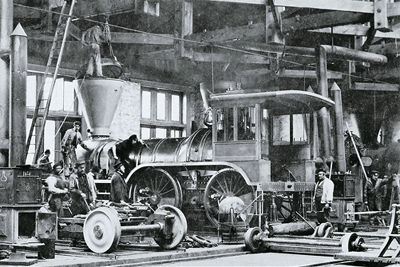
-
Article
Inflation in Canada
Inflation popularly means rising general prices, most frequently calculated by the consumer price index (CPI) — a measure of the cost of a basket of commodities purchased by a typical family.
"https://development.thecanadianencyclopedia.ca/images/tce_placeholder.jpg?v=e9dca980c9bdb3aa11e832e7ea94f5d9" // resources/views/front/categories/view.blade.php
https://development.thecanadianencyclopedia.ca/images/tce_placeholder.jpg?v=e9dca980c9bdb3aa11e832e7ea94f5d9