Share on Facebook
 Share on X
 Share by Email
 Share on Google Classroom
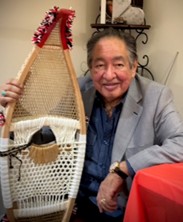
Philip Awashish, leader, negotiator, Elder, advisor (born 1948 near Otter Trail Lake, QC). Elder Philip Awashish is a Cree leader and negotiator who has served as an advisor to Indigenous peoples and governments of Quebec, Canada and the United States. He also served as Deputy Grand Chief of the Grand Council of the Crees and Chief of the Cree Nation of Mistissini. Awashish is one of the most influential Indigenous leaders in Canada.
Early Days
Elder Philip Awashish was born in 1948 in a tent on Inchoukw mehk Saakhiikun (Otter Trail Lake). He is the eldest child of traditional hunters Agnes Voyageur and Isaiah Awashish. They traversed their territory with the seasons, following the animals. Eventually, Awashish had 11 siblings.
In 1954, the Indian Agent and two Royal Canadian Mounted Police officers forcibly took six-year-old Awashish from the family summer home on Lake Mistassini to Bishop Horden Memorial Indian Residential School (later known as Moose Fort Indian Residential School) in Moose Factory, Ontario. He stayed there for seven years. Awashish was then transferred to Shingwauk Indian Residential School in Sault Ste. Marie, Ontario, for two years. Under the abuse and attempted assimilation of the residential schools, he lost his Cree language and cultural knowledge.
He attended Bawating Collegiate and Vocational Secondary School in Sault Ste Marie. He later studied liberal arts and civil engineering at McGill University.
James Bay Northern Quebec Agreement
On 30 April 1971, Premier Robert Bourassa announced the massive James Bay hydroelectric project. Project initiators Hydro-Québec and the Quebec government did not first consult the James Bay Cree, whose territory, Eeyou Istchee, would be partially flooded for the dams. Elder Philip Awashish, then 22 years old, organized the Cree response by spearheading the first-ever gathering of the eight Eeyou Istchee Chiefs. This gathering was also the first-ever deliberately political Eeyou Istchee meeting. The event itself was a significant accomplishment firstly because Eeyou Istchee is over 400,000 km2. Secondly, the communities were new; Indian Affairs had forced the Cree out of their seasonal home system into permanent communities (see also Federal Departments of Indigenous and Northern Affairs). Thirdly, the communities were remote, and most of them lacked road access. Fourthly, the gathering had to be managed without Cree money since Indian Affairs controlled all their funds. And, finally, it had to be managed in defiance of the Indian Act, which rendered Indigenous governments effectively powerless.
After three days’ deliberations (30 June to 2 July 1971), the Cree leaders agreed to approach the hydroelectric project by debating aspects amongst themselves but standing as a unified nation with one voice. This unity prevented opposing forces from minimizing them or using internal discord to dismiss their concerns. Awashish and his residential school friend, Chief Billy Diamond, were assigned to gather information and to be that one voice.
Awashish travelled between communities to explain the process and gather community feedback on video. He then showed these videos to the next communities, gathering further feedback. In this way, he created the first system for Cree political discussions. The input was turned into an official Cree response to the proposed project.
Awashish quickly became known as a formidable and persistent negotiator. In 1973, Judge Albert Malouf, for the first time in Canadian legislative history, explicitly identified the inherent rights of Indigenous peoples. He ordered an injunction on the hydroelectric project, forcing the Quebec government and Hydro-Québec to negotiate with the Cree and Inuit. The Quebec Court of Appeal later overturned the decision, arguing that settlers’ convenience superseded the rights of Northern Indigenous populations. However, both provincial and federal governments recognized the Malouf judgment as a turning point in respecting the existence of intrinsic Indigenous rights. As a result, they negotiated with the Cree and Inuit.
In August 1974, the people of Eeyou Istchee formed the Grand Council of the Crees for three primary purposes. The organization was meant to negotiate hydroelectric dam construction on Cree terms. Additionally, it was responsible for negotiating a modern treaty that instituted an Eeyou Istchee land management regime and enshrined Cree rights, including the right of self-government. Finally, it represented the Cree practising self-governance. Awashish was Deputy Grand Chief and a Principal Negotiator, roles he held until 1988. These negotiations led to the James Bay and Northern Quebec Agreement (JBNQA), Canada’s first modern treaty, signed on 11 November 1975. Awashish was one of the signatories.
For the proper implementation of the JBNQA, the Grand Council of the Crees brought over 30 lawsuits against the governments. All of these lawsuits were settled out of court. The Grand Council also reclaimed and built Cree schools, health clinics, and communities, greatly improving Eeyou Istchee living conditions.
In 1982, treaty rights, including those stemming from land claims as part of the JBNQA, were recognized and affirmed as part of Canada’s Constitution Act, 1982.
Along the way, Awashish re-gained his Cree language and some cultural knowledge.
Other projects and positions
In 1974, footage from Elder Philip Awashish’s community visits was released in a National Film Board of Canada, BAFTA award-winning documentary, Cree Hunters of Mistassini. Awashish facilitated the project and interpreted and translated for it.
Cree Hunters of Mistassini, Boyce Richardson & Tony Ianzelo, provided by the National Film Board of Canada
From 1975 to 1984, Awashish was Principal Negotiator and Commissioner of the Cree-Naskapi Commission. This Commission, especially hard fought, resulted in the Cree-Naskapi of Quebec Act. This act fully separated the James Bay Cree (and Naskapi) of Quebec from the Indian Act, ending its power over them. It permanently altered the relationship between the James Bay Cree in Quebec and the federal government. It was the first Act of its kind and paved the way for other Nations to follow suit. Of note, the 16 implementation reports of the Cree-Naskapi Act had to be submitted in French, English, Cree and Naskapi. This directive set the precedent that Cree and Naskapi languages were of equal Canadian importance to the official languages of French and English.
From 1974 to 1989, Awashish was the Executive Chief and vice chairman of the Grand Council of the Crees. From 1978 to 1979, Awashish was Chief of the Cree Nation of Mistassini (later renamed Mistissini).
From 1975 to 1995, Awashish was appointed a member of the Canadian team negotiating with the Canadian and American governments to amend the 1916 Migratory Birds Convention. This amendment restored to Indigenous hunters in Canada their right to harvest migratory birds year-round, whereas the original Convention had prohibited harvesting in spring and summer.
Awashish is widely regarded as the creator of the Income Security Program, the first of its kind in the world. It was established in 1976 to facilitate a stable Eeyou Istchee shift into a new economy. Now known as the Economic Security program, it provides financial assistance for Cree trappers and hunters practising traditional land-based Cree ways of life. This program marks these ways of life as viable and valued career choices. Studies show that the program has improved the health of participants.
In 2009, Awashish received an Honorary Doctorate of Laws from McMaster University for his work on Indigenous law and governance.